
You just bought your first offshore boat.
Now comes another question that can get expensive very quickly:
How many fishing rods do you actually need?
Walk through a marina and you’ll see completely different answers.
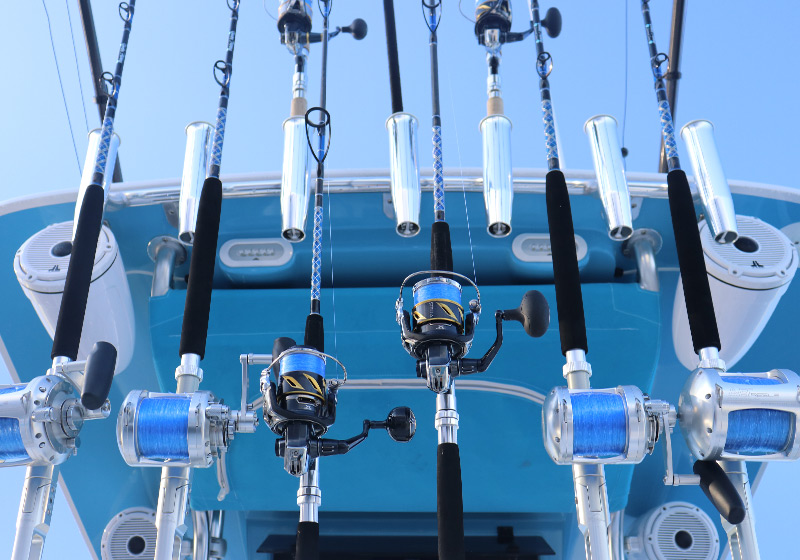
One boat may leave the inlet with six rods.
The boat next to it may have 20.
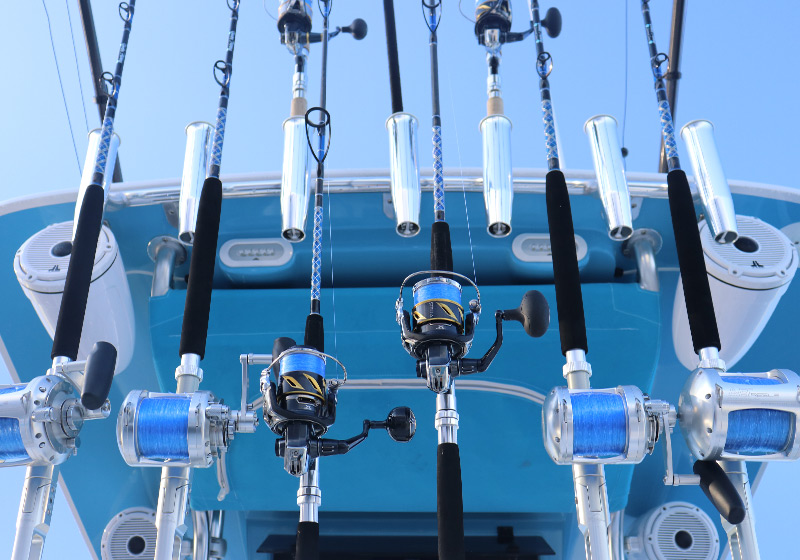
You’ll see spinning rods, conventional rods, stand-up trolling outfits, electric reels, jigging rods, kite rods, and enough specialized equipment to target almost anything swimming off the Florida coast.
But you don’t need to buy all of that on day one.
If someone came into Connley Fishing after buying their first offshore boat, we’d help them build the rod locker in stages.
Start with versatile offshore fishing rods that allow you to do several types of fishing well. Add trolling and lighter spinning equipment as your fishing expands. Then invest in specialized rods when you actually begin using the techniques they’re designed for.
Done correctly, you can start with about six quality setups and cover an incredible amount of South Florida offshore fishing.
Eventually, many serious offshore boats settle somewhere around 12 to 14 rod and reel combinations.
Here’s how we’d build that collection.
The Bare Minimum Offshore Rod Spread
If budget allows, we’d start a new offshore boat with at least six rod and reel combinations plus a gaff.
Our basic starting spread would include:
- Four 7′ Platinum 700L Conventional rods.
- Two 7′ Platinum 700XL Spinning rods.
- One 6′ gaff with a 3″ hook.
That’s a surprisingly capable starting point.
With those six rods, you can begin targeting a wide variety of offshore species and learning several techniques without filling the boat with equipment you don’t yet know how to use.
The four conventional rods form the backbone of the spread.
The two offshore spinning rods give you another tool when casting or pitching becomes important.
And the gaff?
That’s one piece of equipment new boat owners sometimes forget until there’s a quality fish beside the boat and everyone suddenly realizes they don’t have a good way to bring it aboard.
Why We Start With Four All-Purpose Conventional Rods
If you’re ready to outfit the boat with matching all-purpose conventional rods instead of adding them one at a time, our Saltwater 6 Pack of Platinum 700L Conventional rods gives you a complete set built around one of the most versatile offshore rods in our lineup.
It’s an especially strong option for anglers who regularly switch between live baiting, bottom fishing, and general offshore fishing and want consistent equipment across the boat.
For us, that means rods such as the Platinum 700L Conventional.
Why four?
Because these rods can cover an enormous amount of fishing.
Depending on how they’re rigged and the conditions you’re fishing, the same general class of rod can be used when targeting species such as:
- Kingfish.
- Sailfish.
- Blackfin tuna.
- Mutton snapper.
- Grouper.
That’s a lot of capability from one style of rod.
The 700L also gives you the combination we keep coming back to throughout our offshore rod guides: a responsive tip paired with enough backbone for serious offshore fishing.
When you’re buying your first rods, versatility matters.
We’d rather see someone own four quality multipurpose conventional rods than six inexpensive rods that each claim to perform one specific job.
Add Offshore Spinning Rods Next
After your conventional setups, we’d add a pair of quality offshore spinning rods.
Our starting recommendation would be two 7′ Platinum 700XL Spinning rods.
Spinning tackle expands what your boat can do because it gives anglers the ability to quickly cast or pitch baits when opportunities appear.
Offshore fishing changes fast.
A weed line appears.
Mahi show up beside the boat.
Fish begin feeding at the surface.
Someone spots activity away from your trolling spread.
Those are situations where having a rigged spinning rod ready can turn a sighting into a hookup.
That’s why we consider offshore spinning rods part of the basic rod locker rather than highly specialized equipment.
What Your First Six Rods Give You
With four all-purpose conventionals and two offshore spinners, you’ve created a foundation that can handle:
- Live bait fishing.
- Bottom fishing.
- Sailfish.
- Kingfish.
- Blackfin tuna.
- Mahi opportunities.
- Casting and pitching.
- General offshore fishing.
Will those six rods perform every offshore technique?
No.
But they give a new boat owner enough capability to actually learn what kind of fishing they enjoy before spending thousands of dollars on specialized equipment.
That’s a much smarter way to build a rod locker.
How Many Offshore Fishing Rods Should a Boat Carry?
Once you move beyond the bare minimum, we’d expect a well-equipped offshore boat to carry somewhere around 12 to 14 rod and reel combinations.
That’s not a hard rule.
A dedicated trolling boat may build its rod locker differently from someone who spends most weekends bottom fishing. A boat that regularly kite fishes will have different priorities from one that spends most of its time running offshore for mahi.
But 12 to 14 combinations gives anglers enough variety to cover the major techniques without turning every available storage compartment into a rod locker.
The important question isn’t simply:
How many rods can I fit on the boat?
It’s:
How many different fishing jobs can I cover effectively?
A well-planned 12-rod collection can be far more useful than 20 rods purchased without a strategy.
The Offshore Rods That Get Used on Almost Every Trip
Some rods earn permanent status on the boat because they work across so many situations.
Three groups stand out.
1. Seven-Foot All-Purpose Conventional Rods
This includes rods such as:
- Platinum 700L Conventional.
- Platinum 700M Conventional.
- Kingfish rods.
These are the workhorses.
Live baiting, bottom fishing, sailfish, kingfish, blackfin, and other offshore applications can all put these rods to work.
The exact power should be matched to what you’re doing, but this category forms the backbone of a versatile South Florida rod collection.
2. Seven-Foot Offshore Spinning Rods
Examples include:
- Platinum 700XL Spin.
- Platinum 700L Spin.
- Sailfish Spin.
These give you fast access to fish that suddenly appear and provide versatility for live bait and other offshore presentations.
A good offshore spinning rod is one of those pieces of equipment you may not think you’ll need until fish appear next to the boat.
Then everyone wants one.
3. Six-Foot Stand-Up Trolling Rods
Stand-up trolling rods are another category we sell constantly because trolling remains such a fundamental part of offshore fishing.
They allow anglers to pull a variety of offshore baits and target everything from mahi and tuna to much larger pelagic fish, depending on the rod class and reel combination.
Once your initial conventional and spinning setups are covered, stand-up trolling rods are one of the next places we’d invest.
What Order Should You Buy Offshore Fishing Rods?
Most anglers don’t walk into the shop and buy an entire 14-combo rod locker at once.
And there’s nothing wrong with that.
If you’re building your collection one or two rods at a time, we’d prioritize purchases in this order:
- 7′ all-purpose conventional rods.
- Offshore spinning rods.
- Stand-up trolling rods.
- Lighter spinning rods for pitching live baits and reef fishing.
- Specialized rods for the techniques you actually use.
That progression is intentional.
Each of the first purchases dramatically expands what you can do on the water.
By the time you reach specialized equipment, you’ve probably spent enough time offshore to know which techniques deserve dedicated setups.
Maybe you discover you love slow pitch jigging.
Maybe you start deep dropping.
Maybe you get serious about swordfish.
Maybe you begin pulling planers regularly.
That’s when specialized deep sea fishing rods start making sense.
Don’t buy them because you think a complete offshore boat is supposed to have them.
Buy them because you’re actually going to use them.
When You Need a Specialized Offshore Rod
Some fishing techniques simply shouldn’t be forced onto an all-purpose rod.
This is where dedicated equipment earns its place.
Slow Pitch Jigging Rods
Slow pitch rods are built specifically around the action required to properly work slow pitch jigs.
If you become serious about this technique, buy the correct rod rather than trying to make an all-purpose conventional setup behave like one.
Deep Drop Rods
Deep dropping introduces entirely different loads, depths, weights, and often electric reels.
A dedicated deep drop rod is designed around that job.
Swordfish Rods
When you’re pairing a rod with a large LP-style electric reel and targeting swordfish, you’ve entered specialized territory.
That’s not something we’d expect a new offshore boat owner to prioritize immediately.
Planer Rods
Planer fishing is another technique where dedicated equipment makes sense.
If you’re regularly pulling planers, use a rod designed to handle the load rather than sacrificing one of your everyday conventional setups.
The lesson is simple:
Versatile rods should form the foundation. Specialized rods should solve specialized problems.
One Rod Can Target More Species Than You Think
One of the easiest ways to overspend when building an offshore rod locker is believing you need a completely different rod for every fish.
You don’t.
Kingfish, sailfish, blackfin tuna, mutton snapper, and grouper can all be targeted with a Platinum 700L Conventional in the appropriate fishing situations.
Stand-up trolling rods can have an even broader range, targeting everything from mahi and tuna to marlin when the rod and reel class are matched appropriately.
This is why we prefer thinking in terms of techniques and applications instead of species labels.
Ask:
- Am I trolling?
- Live baiting?
- Bottom fishing?
- Pitching a bait?
- Jigging?
- Deep dropping?
- Pulling a planer?
Those questions tell us far more about which rod you need than simply saying you’re going “deep sea fishing.”
Build around the fishing you do, and the species coverage will often take care of itself.
One Rod Can Target More Species Than You Think
One of the easiest ways to overspend when building an offshore rod locker is believing you need a completely different rod for every fish.
You don’t.
Kingfish, sailfish, blackfin tuna, mutton snapper, and grouper can all be targeted with a Platinum 700L Conventional in the appropriate fishing situations.
Stand-up trolling rods can have an even broader range, targeting everything from mahi and tuna to marlin when the rod and reel class are matched appropriately.
This is why we prefer thinking in terms of techniques and applications instead of species labels.
Ask:
- Am I trolling?
- Live baiting?
- Bottom fishing?
- Pitching a bait?
- Jigging?
- Deep dropping?
- Pulling a planer?
Those questions tell us far more about which rod you need than simply saying you’re going “deep sea fishing.”
Build around the fishing you do, and the species coverage will often take care of itself.
The Biggest Mistake When Building Your First Offshore Rod Spread
The most expensive mistake isn’t necessarily buying too many rods.
It’s buying the same equipment twice.
A new boat owner sees how quickly six, eight, or twelve complete rod-and-reel combinations add up and understandably starts looking for places to save money.
So they buy the inexpensive option.
A season later, guides fail.
Components corrode.
Reel seats create problems.
The rod doesn’t perform the way they expected.
And they start replacing everything they thought they had already purchased.
That’s why one of the most consistent pieces of advice we give customers is:
Buy quality equipment the first time.
You don’t need to buy 14 premium setups tomorrow.
Buy four good rods instead of eight poor ones.
Then add to the collection as your budget allows.
Quality components matter tremendously in saltwater. Offshore equipment lives around corrosion, heavy loads, boat storage, sun, spray, and repeated use.
Saving money on the initial purchase isn’t much of a savings if you replace the equipment shortly afterward.
A smaller collection of well-built saltwater fishing rods gives you a much stronger foundation than a packed rod locker full of equipment you don’t trust.
Building a 12-14 Rod Offshore Spread
Once you’ve covered the six-rod foundation, the next step isn’t simply doubling everything you already own.
This is where we start adding capability.
A good 12 to 14-combo offshore rod spread should allow you to switch techniques without having to completely re-rig the boat every time conditions change.
Your exact collection will depend on how you fish, but we’d build around four major groups:
- All-purpose conventional rods.
- Offshore spinning rods.
- Stand-up trolling rods.
- Lighter spinning rods.
Then we’d add specialized equipment according to the techniques you actually use.
For a South Florida boat that fishes a little bit of everything, the collection might begin with four to six all-purpose conventional setups, two to four offshore spinning setups, several trolling outfits, and a couple of lighter spinning rods.
That gives you enough equipment to handle a mixed offshore trip without owning a dedicated rod for every species that swims past the boat.
From there, slow pitch, deep drop, swordfish, kite, and planer setups can be added as needed.
The goal isn’t reaching some magic number.
It’s making sure each rod in the locker has a reason to be there.
Add Lighter Spinning Rods for Mahi and Reef Fishing
Once your heavier offshore spinning rods are covered, we’d add lighter spinning equipment.
This is where rods such as the 7′ Platinum Graphite 15-30 Spinning Rods become useful.
A lighter spinning rod gives you a different tool than the 700XL-class offshore spinner.
It works particularly well when you’re:
- Pitching live bait to mahi.
- Fishing lighter tackle around reefs.
- Targeting smaller snapper.
- Casting smaller baits.
- Looking for a more sensitive presentation.
This is another reason we don’t like building a rod collection exclusively around fish species.
You may use the same lighter spinning rod for mahi one day and reef fishing another.
The technique determines the tool.
Don't Forget the Trolling Spread
Once the basic live-bait and spinning setups are handled, we’d begin building a dedicated trolling spread.
A good set of stand-up trolling rods dramatically expands what the boat can target.
These setups can be used for:
- Mahi.
- Tuna.
- Wahoo.
- Larger pelagic species.
- Marlin, when the rod and reel class are appropriate.
The important thing is keeping the trolling outfits consistent.
When we’re setting a trolling spread, we don’t want six completely unrelated rod-and-reel combinations scattered across the transom.
Matching setups make it easier to manage drag settings, understand how each outfit behaves, and keep the spread organized.
That’s particularly valuable when multiple fish are hooked at the same time.
What We'd Build With No Budget Limit
Now let’s forget about starting small.
Suppose we’re outfitting an offshore boat and budget isn’t part of the conversation.
What would we put aboard?
This isn’t what every boat needs. It’s what a serious, fully equipped Connley offshore rod locker could look like when we’re covering trolling, live bait, spinning, bottom fishing, jigging, kite fishing, and accessories.
Trolling
We’d start with:
- Six 6′ Platinum 30-80 Trolling rods
- Six Shimano Talica 25II reels
- Winthrop Terminator Butts
Then we’d add:
- Six 6′ Platinum 50-100 Trolling rods
- Six Shimano Talica 50II reels
- Winthrop Terminator Butts
This gives us two serious trolling classes instead of forcing one set of rods to cover everything.
The 30-80 setups give us an extremely capable offshore trolling spread, while the 50-100 outfits move us into substantially heavier applications.
Planer Fishing
We’d add:
- Two dedicated Planer Rods
- Two Shimano Talica 50II reels
- Winthrop Terminator Butts
Planer fishing places unique demands on the equipment.
If you’re regularly pulling planers, dedicated rods make far more sense than continually borrowing one of your everyday trolling setups.
Live Bait
Our dedicated live-bait collection would include:
- Six 7′ Platinum 700L Conventional rods
- Six Shimano Talica 20II reels
There’s that 700L again.
Six identical setups give us tremendous flexibility for South Florida live-bait fishing and allow the boat to put multiple baits in the water without mixing completely different equipment.
These rods can see action for kingfish, sailfish, blackfin tuna, and other offshore species.
Offshore Spinning
For heavier offshore spinning work, we’d carry:
- Four 7′ Platinum 700XL Spinning rods
- Four Shimano Stella 10,000 reels
These are the rods we’d want ready when a casting opportunity suddenly appears or we need powerful spinning equipment for larger offshore fish.
Lighter Spinning
We’d also carry:
- Six 7′ Platinum Graphite 15-30 Spinning rods
- Six Shimano Stella 6,000 reels
Now we’ve created another level of versatility.
These setups are excellent for lighter offshore applications, pitching live baits to mahi, and reef fishing where we don’t need the heavier 700XL spinning equipment.
Bottom Fishing and Deep Dropping
For serious deep-water bottom fishing, we’d add:
- Two 6′ Power 7 Carbon 60-130 rods
- Winthrop 10-X Butts
- LP Electric Reels
This is a perfect example of specialized equipment solving a specialized problem.
We aren’t trying to make a 700L do everything.
Once we’re deep dropping with heavy weight and electric reels, we want rods specifically designed around that application.
Slow Pitch Jigging
We’d also carry:
- Two Slow Pitch 450g jigging rods
- Two Shimano Ocea Jigger 2500 reels
Slow pitch jigging deserves purpose-built equipment.
The rod is a critical part of how the jig is worked, so this isn’t an area where we’d recommend grabbing whatever conventional rod happens to be available.
Inshore and Reef Fishing
For lighter reef applications, we’d include:
- Two 7′ Platinum Graphite 12-20 rods
These provide another level below the 15-30 spinning setups and give the boat a light, sensitive option when the heavier offshore equipment isn’t necessary.
Kite Fishing and Boat Accessories
Finally, we’d add:
- Two Platinum Kite Rods
- One 8′ Platinum Carbon Gaff with a 2″ hook
- One 6′ Platinum Carbon Gaff with a 3″ hook
- One Platinum Bait Net
At that point, you’ve gone far beyond a basic offshore rod spread.
You’ve built a rod locker capable of handling an enormous range of South Florida fishing without constantly forcing one setup to perform a job it wasn’t designed to do.
Platinum vs. Diamond vs. BYG: Which Connley Series Fits Your Boat?
Not every angler needs to build the no-budget rod locker we just described.
That’s exactly why Connley offers different series.
Platinum Series
The Platinum Series sits at the top.
If you’re looking for the best components, premium construction, and the best-looking rods we build, this is where we’d point you.
For someone building a premium offshore rod spread and planning to keep the equipment for years, Platinum is the natural choice.
Diamond Series
The Diamond Series sits in the middle.
It gives anglers another option when they want quality Connley construction without stepping all the way into the Platinum level.
This can make a lot of sense when you’re building several combinations at once and need to balance overall budget with performance.
BYG (Blue Young Guns) Series
The BYG Series is our entry-level option.
It’s designed for anglers who want to get into Connley rods at a more accessible price point.
The important distinction is that “entry level” doesn’t mean we think you should buy disposable fishing equipment.
There’s a big difference between choosing the appropriate Connley series for your budget and buying the cheapest offshore rod you can find because you need six of them.
Buy the best quality that makes sense for your situation, then build the collection gradually.
Should Every Rod on the Boat Match?
Not every rod needs to be identical.
But rods performing the same job should ideally be consistent.
If we’re building a six-rod trolling spread, we’d much rather have matching setups than six unrelated rods and reels.
The same applies to a live-bait spread.
Consistency gives you:
- Predictable rod performance.
- Similar drag capabilities.
- Familiar reel operation.
- Easier rigging.
- Cleaner storage.
- Easier replacement and maintenance.
- A more organized fishing experience.
There’s also something to be said for opening the rod locker and seeing a complete set of matching custom rods.
But the functional advantages come first.
Match rods that perform the same job.
Use different rod classes when the job changes.
The Connley Advantage
If you just bought an offshore boat and walked into our shop asking what you need, we wouldn’t try to fill every rod holder on day one.
We’d start with the equipment that lets you fish.
Four 7′ Platinum 700L Conventionals.
Two 7′ Platinum 700XL Spinning rods.
A good 6′ gaff with a 3″ hook.
With those six setups, you can learn an enormous amount about the kind of offshore fishing you actually enjoy.
Then we’d build from there.
Add stand-up trolling rods.
Add lighter spinning equipment.
If you fall in love with slow pitch jigging, buy slow pitch rods.
If you start deep dropping regularly, build a proper deep-drop setup.
If you’re pulling planers, buy dedicated planer rods.
The biggest piece of advice we’d give you is not to sacrifice quality just because you’re staring at a lot of empty rod holders.
You don’t need to fill them all immediately.
Spend the money once on equipment built to last.
Four quality rods today and two more later will usually leave you in a much better position than buying eight cheap rods now and replacing them one at a time.
Build the rod locker around the fishing you actually do.
That’s how you end up with a boat full of rods you use instead of a garage full of rods you regret buying.
Final Thoughts
There isn’t one perfect offshore rod spread for every boat.
A South Florida angler who spends most weekends live-baiting for sailfish and kingfish shouldn’t build the same collection as someone who primarily trolls or deep drops.
But the order in which we’d build those collections remains remarkably consistent.
Start with versatile conventional rods.
Add offshore spinning rods.
Build your trolling spread.
Add lighter spinning tackle.
Then buy specialized equipment as specialized techniques become part of your fishing.
For a new offshore boat, four all-purpose conventionals and two offshore spinning rods give you an excellent six-combo foundation.
As your fishing expands, somewhere around 12 to 14 combinations can create a very capable everyday offshore rod locker.
And if budget isn’t a concern?
That’s when you can start building dedicated trolling sets, live-bait sets, planer rods, deep-drop equipment, slow pitch setups, kite rods, and everything else required to turn the boat into a complete offshore fishing platform.
But whether you’re buying rod number one or rod number twenty, the same rule applies:
Buy for the fishing you actually do, and buy quality the first time.
Frequently Asked Questions
How many offshore fishing rods should I have on my boat?
For someone starting with their first offshore boat, we’d recommend about six quality rod-and-reel combinations as a strong foundation. Our starting spread would be four 7′ all-purpose conventional rods and two 7′ offshore spinning rods, plus a good gaff.
Once you begin fishing regularly and understand which techniques you use most often, a 12 to 14-combo collection gives many offshore anglers an excellent amount of versatility. The exact number isn’t important, though. A boat that primarily trolls may need a different spread than one used for live bait and bottom fishing. Focus on covering the fishing applications you actually use rather than reaching a specific rod count.
What offshore fishing rods should I buy first?
We’d begin with 7′ all-purpose conventional rods. They’re among the most versatile pieces of equipment you can put on a South Florida offshore boat and can cover live bait, bottom fishing, and several major target species.
Next, add offshore spinning rods so you’re prepared to pitch or cast baits when opportunities appear. After that, we’d invest in stand-up trolling rods, followed by lighter spinning rods. Specialized equipment such as slow pitch, deep drop, swordfish, kite, and planer rods should generally come later, once those techniques are actually part of the way you fish.
What is the most versatile offshore fishing rod?
For our fishing, the 7′ Platinum 700L Conventional is one of the most versatile rods in the lineup. It repeatedly shows up in our recommendations because it can be used in appropriate setups for kingfish, sailfish, blackfin tuna, mutton snapper, grouper, and other offshore applications.
That doesn’t mean it’s the perfect rod for every technique. It isn’t a slow pitch rod, deep-drop rod, or heavy trolling rod. Its value comes from how many everyday offshore applications it can cover effectively. That’s exactly the type of rod we’d use to form the foundation of a new offshore collection.
Do I need different rods for every offshore fish species?
No, and trying to buy one rod for every species is one of the fastest ways to build an unnecessarily expensive and confusing rod locker.
We prefer organizing rods around fishing techniques and applications. A quality conventional live-bait rod may be used for kingfish, sailfish, and blackfin. The same rod may cross into certain bottom-fishing applications. A stand-up trolling rod can target several pelagic species depending on its class and reel pairing. Buy specialized rods when the technique requires specialized equipment, not simply because you’re targeting another species.
Are expensive offshore fishing rods worth it?
Quality matters significantly in offshore fishing because saltwater equipment lives in a harsh environment. Rods are exposed to corrosion, heavy loads, sunlight, boat storage, salt spray, and repeated use.
That doesn’t mean every angler needs the most expensive rod available. It means we recommend buying the best quality that realistically fits your budget rather than purchasing a large number of inexpensive setups just to fill rod holders. A smaller collection of dependable rods that can be expanded over time usually makes more sense than replacing cheaper equipment as components fail.
When do I need specialized deep sea fishing rods?
Specialized rods make sense when the technique places demands on the equipment that your everyday offshore rods weren’t designed to handle.
Slow pitch jigging is a good example because rod action is a fundamental part of working the jig correctly. Deep dropping introduces heavy loads, substantial depths, and often electric reels. Planer fishing places its own demands on a rod. Swordfishing can involve large electric reels and specialized tackle. Once you’re regularly using one of those techniques, buying the correct purpose-built rod becomes worthwhile.
Should my offshore rods and reels all match?
They don’t all need to match, but we like consistency within each fishing application.
For example, if you’re running a six-rod trolling spread, matching rod-and-reel combinations make it easier to manage drag, rigging, maintenance, and fish fights. The same logic applies to a set of live-bait rods. Your spinning rods don’t need to match your trolling rods because they’re performing different jobs. Organize the boat into groups of equipment designed for specific applications rather than trying to make every rod aboard identical.