
If you’ve ever broken a fishing rod and thought, “This rod must have been defective”, you’re not alone.
It’s one of the first things many anglers assume after a rod breaks.
The reality is that most broken rods aren’t caused by manufacturing defects. They’re caused by something called high sticking, and it’s one of the most common mistakes anglers make.
At Connley Fishing, we’ve been building and repairing fishing rods for more than 30 years. We’ve seen thousands of rods come back for repair, and one thing has become very clear.
Approximately 95% of the broken rods we see are the result of high sticking.
The good news is that it’s completely preventable.
Once you understand what high sticking is and how it happens, you’ll dramatically reduce your chances of ever breaking a rod this way.
What Is High Sticking?
High sticking happens when the rod tip is raised too high while pressure is being applied to the line.
Imagine fighting a fish.
Instead of keeping the rod pointed out toward the water, you continue pulling back until the tip is pointing almost straight up toward the sky.
Meanwhile, the fish is pulling straight down.
The rod forms a deep “U” shape.
That position forces the upper portion of the rod to absorb far more pressure than it was designed to handle.
Eventually, something has to give.
Most of the time, it’s the rod.
Why High Sticking Breaks Fishing Rods
Every fishing rod is engineered to flex in a specific way.
When the rod stays between roughly the 9 o’clock and 10 o’clock position, the load is distributed through the strongest part of the blank.
As the rod continues upward beyond that point, the pressure begins shifting farther toward the tip.
The farther the rod moves toward vertical, the more stress is concentrated in the weakest section of the blank.
That’s why rods typically fail in the upper third during a high-stick situation.
The rod isn’t weak.
It’s simply being loaded in a way it was never designed to handle.
Understanding the 10 O'Clock Rule
One of the easiest ways to avoid high sticking is to remember the 10 O’Clock Rule.
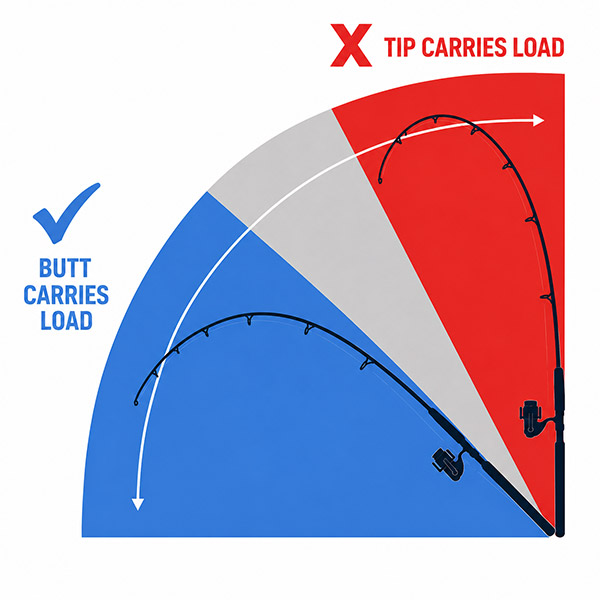
At the 9 O'Clock Position
When the rod is nearly horizontal:
The bottom two-thirds of the rod absorbs most of the load.
This is the strongest part of the blank.
The rod is working exactly as designed.
At the 10 O'Clock Position
As you raise the rod slightly:
The rod continues distributing pressure correctly.
You’re still in a safe fighting position.
This is generally the highest rod angle you should maintain while fighting a fish.
Above the 10 O'Clock Position
Once the rod moves higher:
The load begins shifting into the upper third of the blank.
The tip section absorbs more and more pressure.
The rod is no longer working efficiently.
Continue raising it, and the blank may fail.
Think of it this way.
Point the rod toward the fish, not toward the sky.
That simple adjustment prevents most high-sticking situations.
Most Common Ways Anglers High Stick a Rod
Many people think high sticking only happens while fighting a fish.
In reality, it happens in several different situations.
Fighting a Fish With Long Pumps
This is the most common cause.
As anglers fight a fish, they sometimes make long, exaggerated upward pulls to gain line or simply give their arms a break.
Instead of making short, controlled lifts, they continue raising the rod higher and higher until it becomes nearly vertical.
The fish pulls down.
The rod bends into a deep “U.”
The blank eventually reaches its limit.
The correct technique is much simpler.
Use shorter pumps, keep the rod between the 9 and 10 o’clock positions, and reel quickly as you lower the rod.
You’ll gain line more efficiently while keeping the rod in its strongest working position.
Testing a New Rod in the Yard
Believe it or not, this happens all the time.
Someone receives a brand-new rod in the mail.
They place the butt on the ground.
Then they grab the line and pull straight down to “see how much pressure it can handle.”
Unfortunately, this is almost a perfect example of high sticking.
The rod is pointed straight up.
The pressure is applied straight down.
The rod never has a chance.
If you want to test a rod, do it by fishing with it.
Not by recreating one of the worst loading positions possible.
Pulling on the Line While Rigging
This is another surprisingly common mistake.
An angler is tying a knot or attaching a hook.
The drag is locked down.
To create a little more working line, they grab the line and pull downward while the rod remains pointed upward.
Again, the rod is being loaded exactly like a fish pulling straight down.
The solution is simple.
Before pulling line through the guides, place the reel in free spool.
Never use a locked drag while pulling line against the rod.
Leaving a Rod in the Holder
Picture this.
You’re trolling offshore.
A fish crushes the bait.
Instead of immediately grabbing the rod, the fish dives straight under the boat.
The rod stays in the holder.
The tip loads straight downward.
Within seconds, the rod breaks.
This is another classic high-stick scenario.
Whenever possible, grab the rod promptly and begin fighting the fish from a proper angle rather than allowing the rod holder to force the rod into a dangerous position.
Does High Sticking Damage Every Type of Fishing Rod?
High sticking isn’t limited to one style of fishing rod. It can happen with nearly any rod if it’s loaded incorrectly.
Different rod styles are designed for different techniques, but they all rely on proper rod angles to distribute pressure throughout the blank.
For example:
Kingfish rods are designed to handle long fights with powerful offshore species, but they can still break if the rod is raised too high while the fish is pulling straight down.
Inshore spinning rods are often built with lighter, more responsive blanks, making proper fighting technique even more important.
Premium offshore rods, including our Platinum Series, are built with exceptional components and high-performance blanks, but no rod is designed to withstand the extreme loading caused by high sticking.
The Biggest Misconception About Broken Rods
One of the hardest conversations we have is with customers who believe a broken rod automatically means the rod was defective.
We understand why.
Nobody wants to think they caused an expensive rod to fail.
That’s why we approach these conversations as education, not blame.
One of the first questions we’ll often ask is:
“How many fish have you caught on this rod?”
Many customers answer:
“Dozens.”
Sometimes they’ve owned the rod for years without a single issue.
Then one day it breaks.
The rod didn’t suddenly become defective.
The rod was simply put into a position it wasn’t designed to handle.
Even some of the most experienced captains in the world have accidentally high stuck a rod.
Experience reduces the chances.
It doesn’t eliminate them.
A Real Story From the Water
One story has stayed with us for years.
A customer was fishing in the White Marlin Open and hooked a large tuna.
The fight lasted more than two hours.
Throughout the entire battle, the rod performed exactly as it should.
As the fish finally reached the boat, the customer decided to place the rod back in the holder so he could gaff the fish himself.
At that exact moment, the tuna surged straight down beneath the boat.
The rod loaded heavily.
The tip folded.
The blank exploded.
Naturally, he was frustrated.
Once we explained what had happened and showed him how the rod had been forced into a high-stick position, everything made sense.
The rod had successfully handled two hours of heavy pressure.
It failed only when it was placed in a position no rod is designed to withstand.
How to Fight a Fish Without High Sticking
Good technique protects both your rod and your chances of landing the fish.
Keep these principles in mind:
Keep the rod between the 9 and 10 o’clock positions.
Point the rod toward the fish instead of straight up.
Use short, controlled pumps.
Reel quickly as you lower the rod.
Let the rod and drag work together.
Avoid trying to muscle the fish by lifting with the rod alone.
Remember, your reel retrieves line.
Your rod applies pressure.
When both work together, fighting fish becomes easier and much safer for your equipment.
Choosing the Right Rod Helps, But Technique Matters Most
One of the biggest misconceptions in fishing is that buying a more expensive rod prevents breakage.
The truth is that proper technique matters far more than the price tag.
Whether you’re fishing a Blue Young Guns Series, a Diamond Series, a Platinum Series, or even a Black Magic Series, every rod is designed to flex in a specific way.
Using the proper rod angle will do more to protect your investment than simply upgrading to a higher-end model.
If you’re unsure which series best fits your style of fishing, our Connley Rod Series Guide explains the differences between each lineup and helps you choose the right rod for your needs.
Final Thoughts
Fishing rods are incredibly strong when they’re used the way they were designed.
They’re also surprisingly vulnerable when loaded incorrectly.
Understanding high sticking is one of the most valuable lessons any angler can learn.
It’s knowledge that protects your equipment, saves money, and helps you land more fish.
After building, repairing, and inspecting rods for decades, we’ve learned that preventing high sticking is far easier than repairing the damage it causes.
The next time you’re fighting a fish, remember one simple rule:
Keep the rod between 9 and 10 o’clock.
Your fishing rod will thank you.
Frequently Asked Questions
What is high sticking a fishing rod?
High sticking occurs when the rod tip is raised too high while a fish or another force is pulling downward on the line. This shifts excessive pressure to the upper section of the rod, which can cause it to break.
What percentage of broken fishing rods are caused by high sticking?
Based on our experience repairing rods for more than 30 years, approximately 95% of broken rods we see are the result of high sticking or improper rod loading.
Where do fishing rods usually break from high sticking?
Most rods break in the upper third of the blank because that’s where the pressure concentrates when the rod is raised too high.
Can expensive fishing rods still break from high sticking?
Yes. Premium rods are built with high-quality materials, but no fishing rod is designed to withstand the extreme loading caused by high sticking. Even the best rods can fail if they’re put into the wrong position.
Is high sticking only a problem when fighting fish?
No. It also happens when anglers test rods by pulling down on the line, pull line through the guides with the drag locked down, or leave a rod in the holder while a fish dives beneath the boat.
What's the safest rod angle when fighting a fish?
Keep the rod between the 9 and 10 o’clock positions. This allows the strongest part of the rod to absorb the load while reducing stress on the tip.
If you have questions about choosing the right rod or want to learn more about proper rod handling, our team is always happy to help. After building and repairing rods for decades, we’ve seen just about every situation imaginable, and we’re here to help you keep your gear performing at its best.